

South African blueberries are no longer a niche crop quietly serving a limited seasonal market. They are now part of one of the fastest-moving fruit categories in the world. Global blueberry production has entered a new phase, with output exceeding 2.0 million metric tons for the first time in 2024, according to the International Blueberry Organization. That milestone represents more than simple volume growth. It shows how rapidly blueberries have moved from a specialist health fruit into a mainstream global commodity.
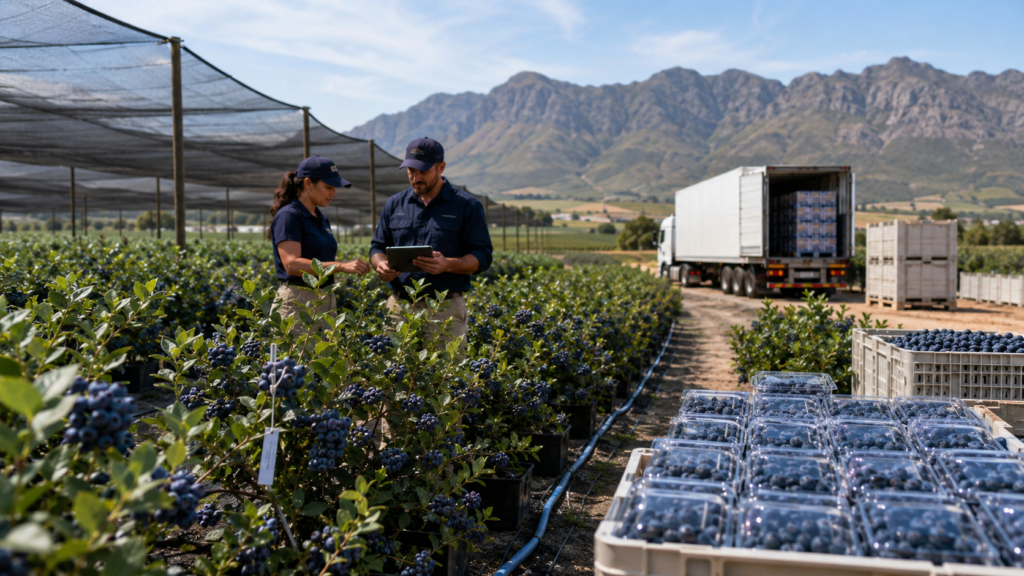
For South African producers, this creates both opportunity and pressure. On the one hand, demand for blueberries continues to rise in key consumer markets. On the other, global production has expanded quickly, competition has intensified, and the export landscape has become far more complex. The question is no longer whether blueberries have a place in global fruit trade. The question is where South Africa can position itself most strongly, and how local growers can protect and grow their export opportunity.
South Africa already has a meaningful position in this market. The country exports blueberries from just over 2 600 hectares, with total domestic production estimated at around 36 000 tons. BerriesZA, the industry body established in 2011, is targeting 25 000 tons of exports per season, up from just over 22 000 tons the previous year. These figures show that South Africa is not standing outside the global blueberry story. It is already inside it.
Yet the industry is operating in a crowded arena. Latin America now commands 42% of global blueberry acreage. China has become the world’s largest producer by volume, accounting for approximately 32% of global output in 2023. Peru has consolidated its position as the world’s leading exporter, with projected campaign volume of more than 323 000 tons for 2024–2025 and estimated export value exceeding USD 2.27 billion.
Against this backdrop, South African growers need more than enthusiasm. They need precision. They need market access. They need reliable logistics, suitable genetics, water security and a clear export strategy that recognises both the scale of the global opportunity and the pressure of international competition.
Why the Global Blueberry Market Has Changed So Quickly
The rise of blueberries has been driven by several linked forces. Nutritional awareness has increased. Consumers in established markets have become more familiar with blueberries as an everyday fruit. Retail availability has improved. Varietal innovation has expanded production possibilities. Perhaps most importantly, blueberries can be commercially cultivated across a remarkably wide range of climates.
This has allowed production to spread across very different growing regions, from the highlands of Peru to warmer areas such as the South African lowveld. That geographic flexibility has changed the structure of global supply. Blueberries are no longer tied to one narrow production window or one dominant region. They are now produced, shipped and sold through a year-round international system.
Rabobank’s 2025 Blueberry Update, as cited in the editorial, reports that Americans now consume approximately three pounds of blueberries per person annually, with consumption still growing. European markets also show strong demand growth potential. This matters for South African producers because export growth depends not only on production capacity, but also on whether consumer demand is still expanding.
The attached editorial makes the central point clearly: despite the extraordinary expansion in global production, industry analysts maintain that demand potential remains far from exhausted. That is encouraging. It means the global market is not simply a closed space where new producers must fight over a fixed level of demand. There is still room for growth.
However, growth in demand does not automatically guarantee profitable export outcomes. When global supply expands at the same time, producers must compete on timing, quality, consistency, market access and cost efficiency. This is where South Africa’s opportunity becomes more specific.
South Africa’s Current Blueberry Position
South Africa’s blueberry industry has grown into a significant export-oriented sector. The country exports blueberries from just over 2 600 hectares and produces an estimated 36 000 tons domestically. BerriesZA is targeting 25 000 tons of exports per season, which reflects a clear export ambition and an organised industry pathway.
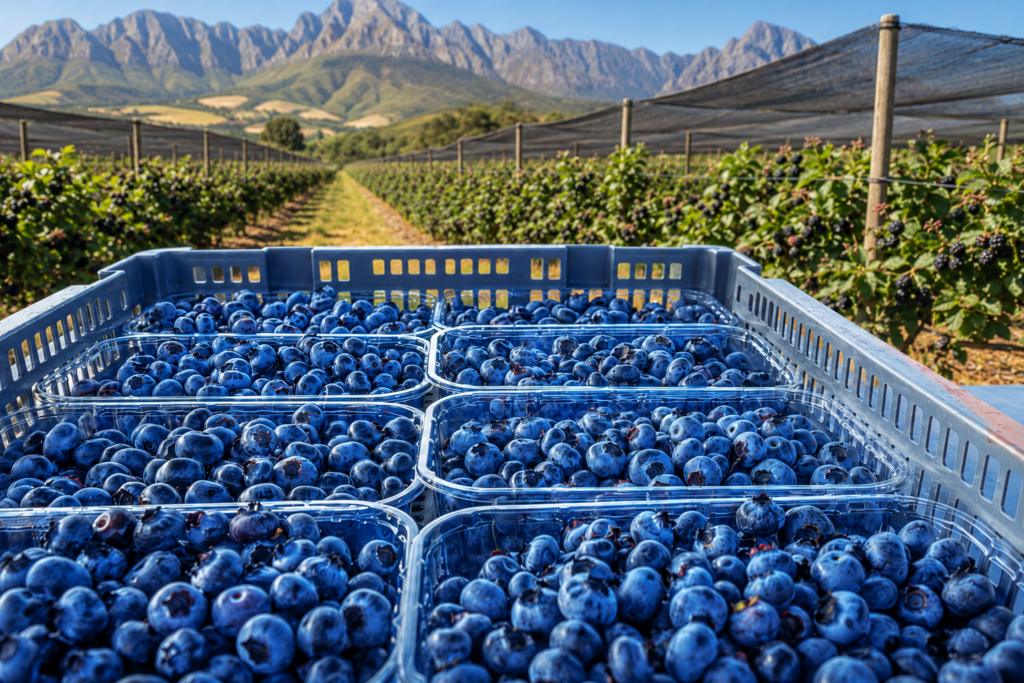
The Western Cape remains the dominant producing region, accounting for at least 60% of output. Limpopo, Mpumalanga and North West also contribute to production. This regional spread gives South Africa some flexibility, especially when considering different climate zones and production timing.
The country’s traditional peak export window runs from October through December. In theory, this gives South African blueberries access to Northern Hemisphere markets during a seasonal supply gap. This counter-seasonal advantage has long been one of South Africa’s strongest export arguments in fresh produce.
But the global blueberry industry has changed. South Africa’s export window is no longer uncontested. When local volumes peak in October and November, Peruvian blueberries are also entering the same European and UK shelf space in large volumes. That creates pressure on pricing, shelf presence and buyer preference.
This is one of the most important realities for South African producers. The opportunity is real, but the timing challenge is also real. South Africa cannot rely only on being counter-seasonal. It must be strategically counter-seasonal.
The Peru Pressure: Why Timing Matters
Peru has become the world’s leading blueberry exporter. Its projected campaign volume of more than 323 000 tons for 2024–2025 shows the scale of the competition. Peru also has market access to far more countries than South Africa currently does. That gives Peruvian exporters more flexibility when volumes rise.
This is not a small advantage. If a country has access to many markets, it can move fruit across destinations more strategically. It can redirect surplus volume. It can protect pricing in certain markets. It can reduce dependence on one or two major buyers. South Africa’s export industry does not yet have the same level of market access flexibility.
The timing overlap with Peru is therefore one of South Africa’s most important strategic challenges. When South African fruit arrives at the same time as heavy Peruvian volumes, local growers face stronger competition in the very markets they rely on.
This is why early-season genetics have become so important. BerriesZA Operations Manager Elzette Schutte has indicated that developing early-season genetics that reach markets before Peru arrives is now a strategic priority, not a wish list item. That statement captures the shift in thinking. Export success is not only about producing more blueberries. It is about producing the right blueberries at the right time for the right markets.
Early-Season Genetics and the MegaEarly Example
The MegaEarly variety, trialled across multiple sites in South Africa during 2024 and 2025, offers an important example of how varietal development may help local growers respond to global competition.
According to the editorial, MegaEarly demonstrated a first pick as early as late April in the Western Cape. That is well ahead of traditional harvest windows. In the warmer Brits region of North West, peak production runs from May to September. The variety recorded average fruit firmness at a durofel score of 86, average diameter of 19–20mm and sugar Brix of 13.
Those figures matter because early timing alone is not enough. A variety must also deliver marketable fruit. Export buyers require quality, firmness, size and eating experience. If early-window varieties can combine timing advantages with acceptable fruit quality, they may help South African producers reduce exposure to peak-season competition.
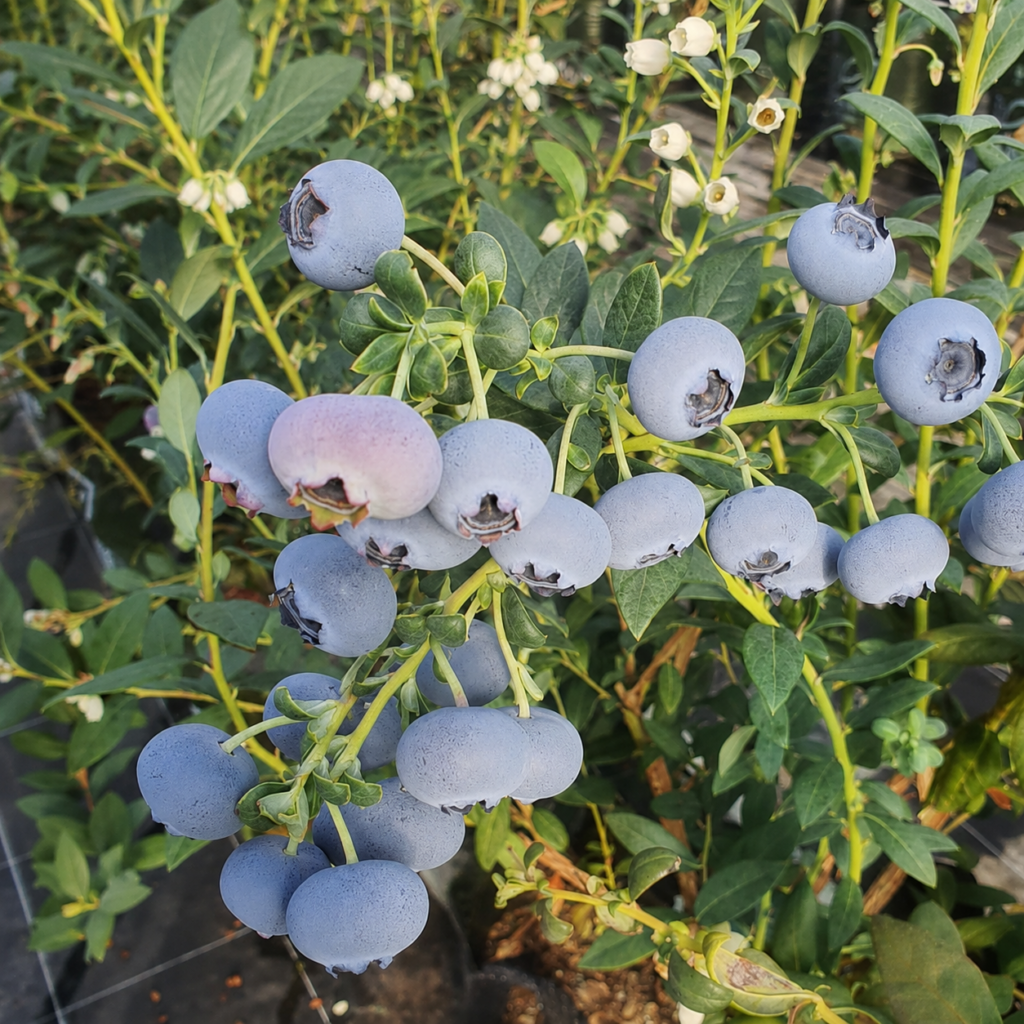
This does not mean every grower should automatically move into early varieties without careful assessment. The editorial does not make that claim, and neither should the industry. What the data does show is that early-season production is a credible strategic direction for growers seeking to de-risk their export position against heavy Peruvian competition.
For South Africa, genetics are not just a production issue. They are an export positioning issue. The right variety can influence when fruit reaches the market, how it travels, how it compares on shelf and how strongly it supports the country’s broader export goals.
Market Access: The Gatekeeper of Growth
Market access is one of the most important factors determining South Africa’s future blueberry growth. The editorial states that South African blueberries are currently exported to 25–29 countries. The EU has overtaken the UK as the primary destination, while Middle Eastern markets are growing significantly.
Countries such as Saudi Arabia and the UAE have reportedly shown year-on-year import increases of around 50%. Malaysia, Singapore and other Far East markets are also increasing their share. India remains a near-term target, with the pest risk assessment process still underway. China is described as a longer-term strategic goal.
This is where the export opportunity becomes clear. Global demand may be expanding, but producers can only benefit from that demand if they are allowed into the market. Market access determines where fruit can go, how risk can be spread and how dependent the industry remains on existing destinations.
For South Africa, wider export access would create several potential advantages. It would reduce overreliance on traditional markets. It would give exporters more room to manage supply pressure. It would help the industry respond more effectively when one destination is oversupplied or under price pressure. It would also allow South African growers to participate more fully in regions where blueberry consumption is still growing.
The global blueberry market was valued at USD 3.08 billion in 2025 and is projected to reach USD 6.04 billion by 2034, with a compound annual growth rate of 7.77%, according to Market Data Forecast as cited in the editorial. That growth trajectory is significant. But South Africa’s ability to benefit from it depends heavily on whether market access continues to expand.
The EU, UK and Middle East: Where South Africa Stands Now
The EU overtaking the UK as the primary destination for South African blueberries marks an important shift. The UK has long been a familiar export destination for South African fruit, but the EU’s growing role shows how destination priorities can change as buyer demand, trade conditions and competitive dynamics evolve.
European demand potential remains strong, but Europe is also a competitive market. South African exporters must compete with other Southern Hemisphere and global suppliers. Quality, timing, reliability and compliance all matter.
The Middle East presents another important export avenue. The editorial highlights significant growth in imports from countries such as Saudi Arabia and the UAE. These markets may offer South African exporters an opportunity to diversify away from traditional destinations and participate in regions where demand is increasing.
Malaysia, Singapore and other Far East markets are also increasing their share. While the editorial does not provide detailed volume figures for each of these destinations, the direction is clear: South Africa’s export future will likely depend on a wider and more balanced destination mix.
That balance is important. A strong export sector should not be overly exposed to one market, one buyer group or one seasonal window. The more market options South African blueberries have, the better the industry can manage risk.
India and China: Strategic Markets, Not Instant Solutions
India is identified in the editorial as a near-term target, with the pest risk assessment process still underway. China is described as a longer-term strategic goal.
These markets are important, but they should be treated accurately. The editorial does not state that South African blueberries already have open access to India or China at scale. It presents India as a process still underway and China as a longer-term objective. That distinction matters.
Market access is not created by interest alone. It requires technical processes, phytosanitary approval, compliance systems, buyer development and logistics planning. For producers, this means India and China should be viewed as strategic opportunities, not immediate guaranteed outcomes.
Still, the importance of these markets is obvious. Both represent large consumer bases. If South African blueberries gain stronger access over time, the industry may be able to diversify its export base and reduce reliance on current destinations. That would be especially valuable in seasons where European or UK pricing comes under pressure.
Water Security: The Non-Negotiable Constraint
No serious discussion about South African blueberry growth can ignore water. The editorial is explicit: water remains the most fundamental limiting factor for South African blueberry expansion.
This is not framed as a distant risk. It is a present-day constraint. Unlike land availability, which is not described as the primary limitation, clean and reliable water supply is under sustained pressure across all producing regions.

Blueberries require consistent, high-quality irrigation, typically through drip systems under shade netting. Any deterioration in water access directly limits the industry’s growth ceiling. This point is crucial because export growth cannot be separated from production stability.
A grower may have market demand. A packhouse may have export ambition. An industry body may have volume targets. But without reliable water, production cannot expand sustainably.
Water security therefore sits at the centre of South Africa’s blueberry future. It affects yield stability, fruit quality, production planning and long-term investor confidence. It also affects whether South Africa can sustain the 25 000-ton export target and eventually move beyond it.
Shade Nets, Tunnels and the Protected Farming Advantage
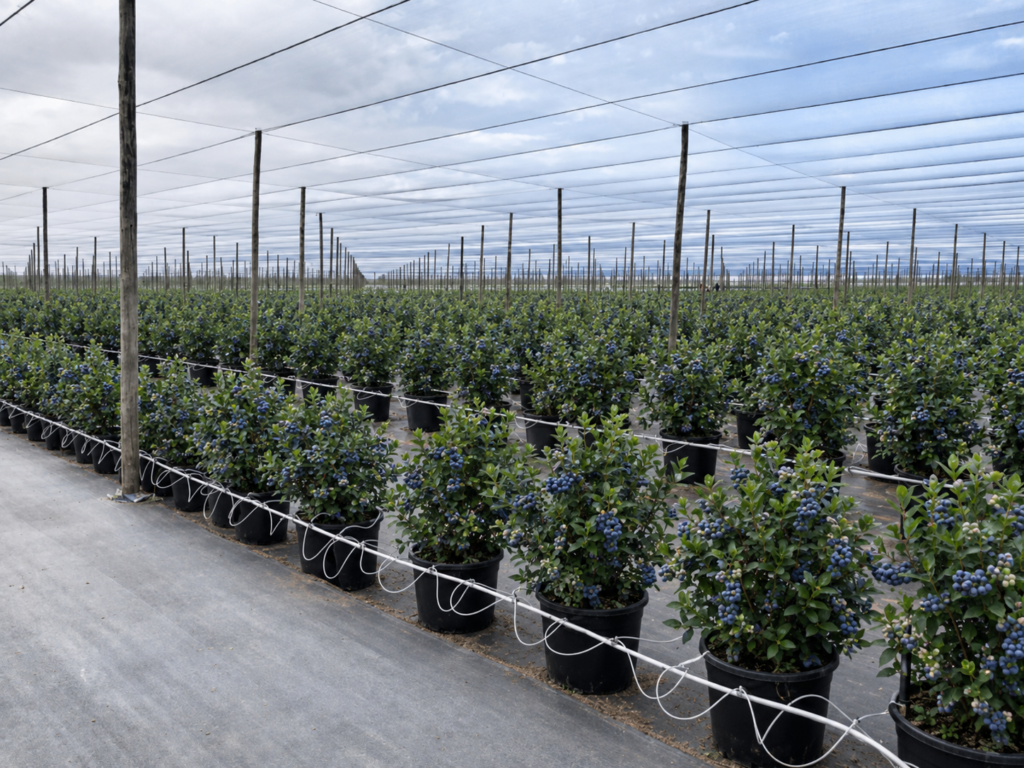
The editorial specifically refers to South African producers operating under shade nets and tunnel systems. This is important for the Undercover Farming audience because blueberries are a strong example of how protected agriculture can support high-value export crops.
Shade nets and tunnel systems can form part of a more controlled production environment. For blueberries, which require consistent water management and quality-focused production, these systems can support the agronomic platform needed for export competitiveness.
However, infrastructure alone is not enough. Protected systems must be paired with strong genetics, careful irrigation, market-focused production planning and reliable post-harvest handling. The export market does not reward infrastructure for its own sake. It rewards consistent, high-quality fruit that arrives at the right time and meets buyer expectations.
This is where South African undercover producers may have an important role to play. The country already has growers using protected systems. The challenge is to align those systems with market realities: earlier windows, quality consistency, water efficiency and access to suitable destinations.
Scale, Genetics and Logistics: The Three Competitiveness Pillars
The editorial states that the message from 2025, including the IBO Summit held in South Africa in September 2025, was emphatic: scale, genetics and logistics will determine future competitiveness.
These three pillars are worth unpacking.
Scale
Scale matters because global competitors are moving large volumes. Peru’s projected campaign volume alone shows how significant the scale gap can be. South Africa does not need to become Peru, but it does need enough scale to serve export markets reliably, justify market development and maintain relevance with international buyers.
Scale also supports investment in packhouses, logistics, technical expertise and market access efforts. Without sufficient export volume, it becomes harder to compete consistently.
Genetics
Genetics influence timing, fruit quality, firmness, size, flavour and market suitability. In a crowded export environment, the right genetics can help South Africa differentiate by window and quality. Early-season varieties are especially important where they help growers reach markets before peak Peruvian pressure.
Logistics
Logistics determine whether fruit arrives in good condition, on time and at a cost that still supports grower profitability. Blueberries are a high-value fresh product, and export success depends on maintaining quality throughout the supply chain. The editorial also notes that logistics costs are among the macroeconomic headwinds creating pressure on the supply-demand balance.
Together, scale, genetics and logistics form the practical foundation of South Africa’s blueberry competitiveness.
The Role of Quality in a Crowded Global Market
When production rises globally, quality becomes more important, not less. Buyers with more supply options can be more selective. Retailers can compare fruit from multiple origins. Consumers can form expectations around size, taste, firmness and consistency.
For South African exporters, this means quality must remain central to the export strategy. A growing market does not excuse inconsistent fruit. In fact, a growing market often raises expectations because buyers become more experienced and consumers become more demanding.
The editorial notes that the global blueberry industry is betting on quality and growth toward 2027. That phrase is important. Growth alone is not the goal. Quality growth is the goal.
South African producers under shade nets and tunnel systems have an agronomic platform that can support quality-focused production. But that platform must be protected by reliable water, suitable varieties and sound logistics.
South Africa’s Opportunity in Global Context
South Africa’s opportunity is not based on being the biggest producer. Current figures do not support that position. China, Peru and Latin American producers occupy much larger positions in global production or export acreage.
South Africa’s opportunity lies in strategic positioning. The country can compete through counter-seasonal supply, quality-focused production, early-window genetics, protected farming systems, improved market access and diversified export destinations.
The export target of 25 000 tons per season is a meaningful industry marker. It shows ambition, but it also creates responsibility. Sustaining and growing that target will require coordinated effort across growers, packers, industry bodies and market access stakeholders.
The opportunity is therefore real, but conditional. South Africa can expand in the global blueberry market if it addresses the constraints that determine competitiveness. Water must be secured. Market access must expand. Early-season genetics must be evaluated and adopted where commercially suitable. Logistics must remain reliable. Quality must be protected.
What South African Producers Should Take from the Data
The data points in the editorial tell a clear story.
Global blueberry production has passed 2.0 million metric tons. Planted area exceeds 267 000 hectares globally. Demand potential remains strong in several markets. South Africa produces around 36 000 tons and is targeting 25 000 tons of exports per season. The Western Cape accounts for at least 60% of output. South Africa exports to 25–29 countries. The EU is now the primary destination. Middle Eastern markets are growing. India and China represent future market access opportunities. Water is the most fundamental constraint.
This is not a story of guaranteed growth. It is a story of disciplined opportunity.
Producers should not read global demand growth as a promise that all fruit will find a profitable home. They should read it as a signal that the market is still expanding, but that competition will reward the most prepared exporters.
The Road Ahead for the South African Blueberry Industry
The IBO’s 2025 Global Outlook concluded that the blueberry market’s potential is far from exhausted. At the same time, macroeconomic headwinds such as inflation, logistics costs and labour shortages are creating pressure on the supply-demand balance.
For South Africa, that means optimism must be matched with realism. The industry has the infrastructure and agronomic platform to compete, especially among growers using shade nets and tunnel systems. But future export success will depend on how effectively South Africa responds to water constraints, market access limitations, competition from Peru and the need for earlier production windows.

The strongest path forward is not simply to plant more hectares or chase volume for its own sake. The stronger path is to build a more resilient export industry. That means producing fruit that fits market windows, expanding access to destinations that can absorb growth, protecting water resources, improving logistics and maintaining quality.
South African blueberries are already part of the global market. The next phase is about strengthening that position.
Conclusion: A Competitive Future Built on Precision
The South African blueberry industry stands at an important point. The global market is growing, but it is also crowded. Demand remains promising, but competition is intense. Export opportunities exist, but access determines who can participate. Production potential is present, but water security determines how far the industry can grow.
For South African producers, the opportunity is not vague. It is measurable. The country already produces around 36 000 tons, exports to 25–29 countries and is targeting 25 000 tons of exports per season. The EU, Middle East, Far East, India and China all form part of the wider market access conversation. Early-season genetics such as MegaEarly show how production timing may help reduce exposure to direct Peruvian competition.
The future of South African blueberries will not be won by guesswork. It will be won by tested production systems, verified market access progress, suitable genetics, reliable water, disciplined logistics and consistent quality.
In a global blueberry market moving at speed, South Africa has a clear place. The challenge now is to protect that place, sharpen it and expand it with precision.
Q&A: South African Blueberries and the Global Export Opportunity
1. Why are South African blueberries suddenly such an important export crop?
South African blueberries have become important because they fit into a fast-growing global market where demand is still rising. The country already produces around 36 000 tons and exports to 25–29 countries, which means blueberries are no longer a small side crop. They are now part of a serious export conversation. With the right varieties, strong water planning and wider market access, South Africa can strengthen its place in the global blueberry trade.
2. What makes South Africa’s blueberry export window valuable?
South Africa’s traditional peak season runs from October to December, which gives local growers access to Northern Hemisphere markets when those regions are outside their main production season. That counter-seasonal timing can be valuable. However, the export window is under pressure because Peru also sends large volumes into Europe and the UK during October and November. This means South Africa’s timing advantage must now become more precise.
3. Why is Peru such a major challenge for South African blueberry growers?
Peru is currently the world’s leading blueberry exporter, with massive projected campaign volumes. It also has access to more markets than South Africa, which allows Peruvian exporters to move fruit more flexibly when supply is high. For South African growers, this creates direct export competition, especially in Europe and the UK. That is why early-season varieties and wider market access have become so important.
4. How can early-season varieties help South African producers?
Early-season varieties may help South African producers reach global markets before the heaviest Peruvian volumes arrive. The MegaEarly variety, for example, showed a first pick as early as late April in the Western Cape during trials. If varieties like this deliver quality fruit at the right time, they can give growers a stronger export position and reduce pressure during the crowded October and November window.
5. Why is market access so critical for the blueberry industry?
Market access determines where South African fruit can legally and commercially be sold. Even if growers produce excellent fruit, they cannot benefit from demand in a country without the correct access. South Africa currently exports blueberries to 25–29 countries, but expanding into more markets would give the industry greater flexibility. A stronger export footprint means less dependence on one or two major destinations and better protection when prices come under pressure.
6. Which markets offer growth potential for South African blueberries?
The EU has overtaken the UK as South Africa’s primary blueberry destination, while Middle Eastern markets such as Saudi Arabia and the UAE are showing strong growth. Malaysia, Singapore and other Far East markets are also becoming more important. India is a near-term target, while China remains a longer-term strategic opportunity. These markets could all play a role in South Africa’s future export growth if access and logistics continue to improve.
7. What is the biggest threat to South Africa’s blueberry expansion?
Water is the most fundamental constraint. Blueberries need consistent, high-quality irrigation, usually through drip systems under shade netting. Without reliable water, the industry cannot expand sustainably, no matter how strong global demand becomes. This means South Africa’s export future depends not only on markets and varieties, but also on long-term water security.
8. What must South Africa do to become more competitive globally?
South Africa must focus on four things: better market access, earlier and suitable genetics, reliable logistics, and water-secure production systems. The country does not need to be the biggest producer in the world to win. It needs to be a smart, consistent and quality-driven export supplier. In a crowded global blueberry market, precision will matter more than volume alone.
(S.0)