
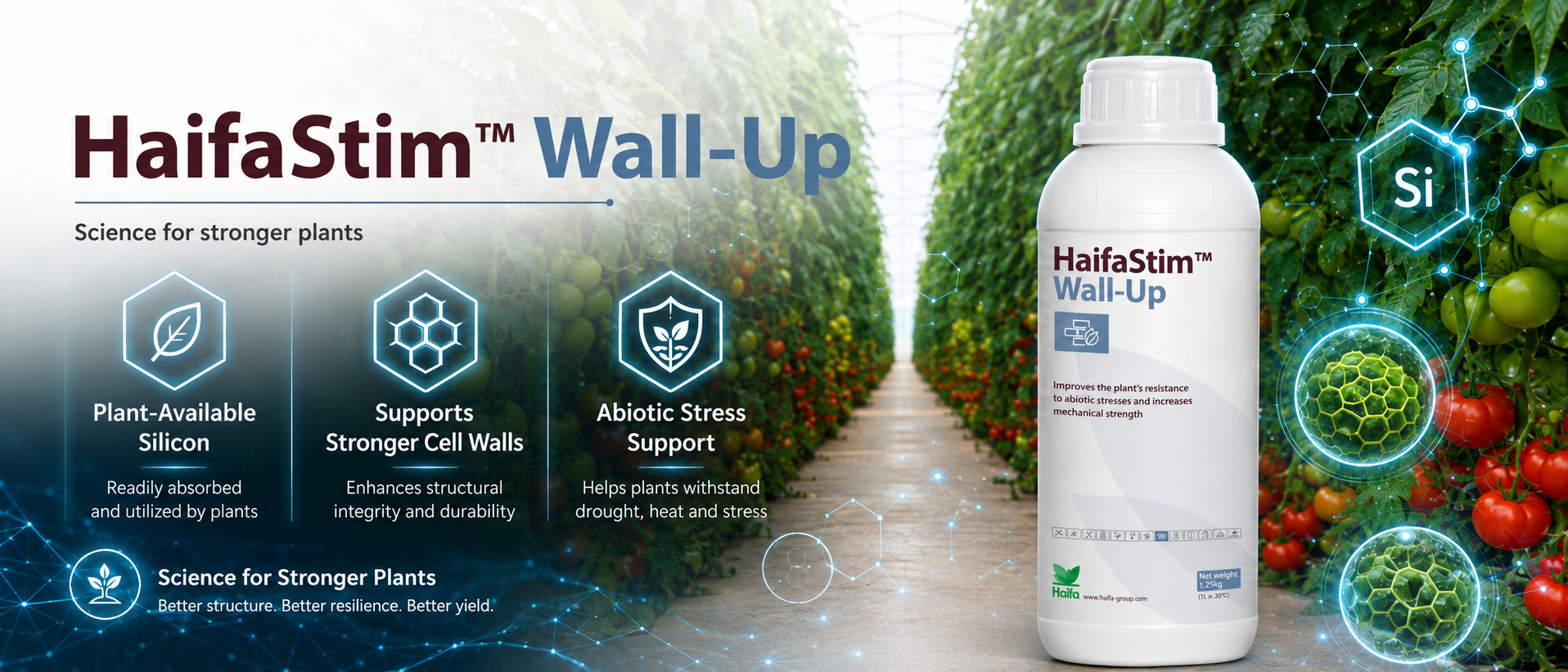
In modern undercover farming, crop success is no longer only about producing more. It is about producing better, stronger and more resilient crops under pressure.
Growers working under greenhouses, shade nets, tunnels and hydroponic systems face a very specific set of challenges. Plants must perform in high-density systems. Nutrition must move efficiently through fertigation programmes. Crop protection products must integrate smoothly with plant nutrition. Heat, cold, drought, salinity, pests, diseases and physical stress all place pressure on production.
That is why silicon is receiving renewed attention.
In the May/June 2026 edition of Undercover Farming Magazine, Haifa Group’s HaifaStim™ Wall-Up S was presented as a stabilised orthosilicic acid biostimulant designed to support stronger, more resilient crops in intensive undercover production systems. The article was based on a presentation by Werner van der Nest of Haifa Group at the Undercover Farming Symposium in March 2026.

For growers who depend on consistent quality, efficient fertigation and reliable plant performance, this is not a small topic. It is a practical production decision.
Why Silicon Deserves More Attention in Undercover Farming
Silicon is the second most abundant element in the Earth’s crust, yet its role in plant health is often underestimated. In undercover farming, where the goal is controlled production, high crop value and reliable output, that oversight can cost growers.
According to the Haifa article, silicon supports plants in three major ways: physiologically, mechanically and at the soil level.
Physiologically, silicon helps fortify plant defence systems. This can make crops more resilient against pathogens and insect pests. It also supports the uptake of potassium, phosphorus and calcium, helping plants maintain better nutritional balance during stressful periods.
Mechanically, silicon strengthens cell walls and plant tissues. This matters in systems where crop presentation, fruit quality and structural strength can directly influence marketability. Stronger cell walls may help reduce pathogen ingress and improve overall crop appearance in high-density undercover production.
At soil level, silicon helps improve phosphorus availability and supports long-term fertility by improving the soil-plant interface. In simple terms, silicon is not only about stronger leaves or stems. It supports the full crop system, helping growers build more resilient production from root zone to harvest.
Why the Form of Silicon Matters
Not all silicon products work the same way.
One of the most important points in the Haifa article is that the form of silicon determines whether the plant can actually use it. Orthosilicic acid is described as the only form of silicon that is directly plant-available. Conventional silicate products must first undergo conversion before uptake can happen, which can make them inefficient and unreliable under certain growing conditions.
This is especially important in fertigation-driven undercover systems.
Many conventional silicates carry a pH above 11. That can create problems in practical farm management. High-pH silicates may require pH correction before application. They may be difficult to mix into fertigation systems. They can also increase the risk of blocked drippers and irrigation nozzles.
For an undercover grower, blocked drippers are not a small inconvenience. They can quickly become a crop performance issue. In a controlled system, uneven delivery can mean uneven growth, weaker plants and lower quality.This is where HaifaStim™ Wall-Up S stands out in the article. It is formulated around orthosilicic acid technology and is designed to be compatible with how intensive growers actually operate.
What Makes HaifaStim™ Wall-Up S Different?
HaifaStim™ Wall-Up S is presented as a highly concentrated dry formulation based on orthosilicic acid technology. According to the article, it has a near-neutral pH of 7.7 in solution and contains 42.8% silicon oxide.
For undercover farmers, this matters because the product is fully mixable in hydroponic systems, requires no pH adjustment, carries no stated risk of nozzle or dripper blockage, and is compatible with most plant protection products and foliar fertilisers. The exception noted in the article is sulphur preparations, where Haifa Group recommends a small-scale compatibility test before tank mixing.
That compatibility is a major point.
Modern undercover farming depends on integration. Nutrition, irrigation, crop protection and plant health programmes must work together. A product that strengthens plants but disrupts the fertigation system is not practical. A product that supports resilient crop growth while fitting into existing systems is far more useful.
HaifaStim™ Wall-Up S was designed for that space: high-value crops, precise fertigation, foliar application and systems where reliability matters.
The Role of Iron in HaifaStim™ Wall-Up S
HaifaStim™ Wall-Up S does not only provide silicon. It also contains iron as a fully water-soluble EDTA chelate.
The Haifa article explains that this iron content supports greening and stress tolerance. It works alongside orthosilicic acid to help the plant manage oxidative damage during periods of heat or cold stress, when free radical activity increases. Together, silicon and iron support cellular energy processes, photosynthesis and the plant’s ability to maintain productivity under difficult conditions.
This is highly relevant for South African undercover growers.
Heat stress, water pressure and production intensity are everyday realities. A crop that remains greener, stronger and more resilient during difficult periods gives the grower a better chance of protecting yield quality and marketable output.
When Should Growers Use HaifaStim™ Wall-Up S?
According to Haifa Group’s application guidance in the article, HaifaStim™ Wall-Up S is recommended during periods of maximum production and peak nutrient absorption. In hydroponic systems, it is recommended throughout the growth cycle.
It is suited to both foliar application and Nutrigation™, which makes it practical for different undercover production models. It is also approved for use in organic farming under EU Regulations 2018/848 and 2021/116.
The article also highlights specific growth stages where Wall-Up S becomes especially relevant. These include rapid tissue expansion, intensive vegetative growth and fruit development. These are the times when plants need mechanical reinforcement and stronger physiological support.
For growers, this means the product should not be viewed as a random add-on. It fits into moments when the crop is building structure, carrying fruit and absorbing nutrients at a high rate.
That is when a more resilient plant system can make the greatest difference.
What Growers Can Expect from Regular Wall-Up S Use
Based on Haifa Group’s product data and field experience referenced in the article, regular use of HaifaStim™ Wall-Up S may support several production benefits.
These include stronger plant cell walls and tissues, improved water use efficiency, increased productivity, improved yield quality and extended post-harvest life. The article also notes greater tolerance to abiotic stresses such as drought, heat, cold and salinity, along with improved resistance to pathogens and insect pests.
Nutritionally, Wall-Up S may help improve uptake of potassium, phosphorus and calcium. It may also help reduce toxicity effects from heavy metals in the growing environment.
For undercover farmers, these benefits all point in the same direction: stronger, healthier and more resilient crops that are better able to perform under pressure.
This is not only about yield. It is about quality, shelf life, pack-out potential and reducing avoidable crop stress.
The Lettuce Trial: What the Results Showed
The article includes a field example from Haifa Iberia on Iceberg lettuce in Murcia, Spain.
Over six weeks of weekly foliar applications at 0.5 litre per hectare, treated lettuce heads averaged 480 g compared to 420 g in the untreated control. The treated crop also showed reduced tip-burn, greener leaves and extended shelf life.
For growers, this is important because these are not abstract benefits. Head weight, colour, tip-burn and shelf life all affect marketable yield.
In undercover farming, marketable yield is where profit is protected. A crop may grow, but if quality is inconsistent, shelf life is poor or visible stress symptoms reduce market appeal, the grower still loses value.
This is why resilient crop nutrition matters. The goal is not simply to push plants harder. The goal is to help them perform better and recover more effectively under production pressure.
Why Wall-Up S Fits Undercover Production Systems
Undercover farming is built around control. Growers invest in shade nets, tunnels, greenhouses, hydroponics, fertigation and crop monitoring because they want to reduce uncertainty.
But no system removes stress completely.
Plants still face heat, cold, salinity, water stress, pests, diseases and physical pressure. High-value crops also carry high expectations. Buyers want consistency. Retailers want quality. Export markets want reliability. Consumers want produce that looks fresh and lasts longer.
HaifaStim™ Wall-Up S fits this environment because it supports the plant from inside the tissue structure. Stronger cell walls, improved stress tolerance and better nutrient uptake all support the kind of resilient production that undercover growers are trying to achieve.
It also fits the technical needs of these systems. A near-neutral pH, compatibility with most plant protection and foliar fertiliser programmes, and suitability for Nutrigation™ make it easier to integrate into a professional crop programme.
That is the real value: practical compatibility plus plant performance.
Silicon as a Strategic Input, Not Just a Supplement
The Haifa article makes a strong point: silicon should not be seen only as a beneficial element. It should be viewed as a strategic input for modern, sustainable farming.
That matters because undercover growers are no longer farming in a low-pressure environment. Input costs are rising. Climate stress is increasing. Water use must be justified. Crop quality must be consistent. Production systems must become more efficient.
In that environment, every input must earn its place.
A strategic input is one that supports the bigger production goal. HaifaStim™ Wall-Up S supports stronger plant structure, improved stress tolerance, nutrient efficiency and quality outcomes. These are exactly the areas that determine whether a crop system becomes more resilient over time.
For South African growers, that makes silicon worth a much closer look.
A Practical Takeaway for Growers
The biggest lesson from the Haifa article is simple: the right silicon source can make a measurable difference.
Conventional silicates may create practical challenges in pH management, compatibility and fertigation performance. Orthosilicic acid offers direct plant availability. HaifaStim™ Wall-Up S adds a concentrated, system-compatible option for growers who want to strengthen crops without complicating their nutrition programme.
For greenhouse, shade-net, hydroponic and high-density undercover systems, the fit is clear.
Growers should evaluate HaifaStim™ Wall-Up S where crops need stronger tissue, improved stress tolerance, better quality and more resilient performance through demanding production stages.
This is especially relevant during rapid growth, intensive vegetative development, fruit formation, high-production periods and full hydroponic crop cycles.
Conclusion: Building More Resilient Crops from the Inside Out
Undercover farming is about giving crops better protection, better control and better production conditions. But protection does not end with the structure above the crop. It also depends on what happens inside the plant.
Silicon helps strengthen that internal structure.
HaifaStim™ Wall-Up S, as presented by Haifa Group, offers undercover growers a concentrated orthosilicic acid solution designed for modern crop systems. It supports cell wall strength, nutrient uptake, stress tolerance, quality and shelf life. It also fits into fertigation and foliar programmes without the practical complications often associated with conventional silicates.
For growers looking to build stronger, cleaner and more resilient crops, silicon deserves a place in the conversation.
And for undercover farming systems built around precision, quality and reliability, HaifaStim™ Wall-Up S offers a practical way to support resilient production from the inside out.
FAQs
Frequently Asked Questions About HaifaStim™ Wall-Up S
1. What is HaifaStim™ Wall-Up S?
HaifaStim™ Wall-Up S is a stabilised orthosilicic acid biostimulant from Haifa Group. It provides plant-available silicon and iron to support stronger cell walls, better stress tolerance and improved crop quality.
2. Why is orthosilicic acid important?
Orthosilicic acid is described in the Haifa article as the only directly plant-available form of silicon. This makes it different from conventional silicates, which must first be converted before the plant can use them.
3. Can HaifaStim™ Wall-Up S be used in hydroponics?
Yes. According to the article, HaifaStim™ Wall-Up S is fully mixable in hydroponic systems and is recommended throughout the growth cycle in hydroponic production.
4. Does HaifaStim™ Wall-Up S block drippers?
The article states that HaifaStim™ Wall-Up S carries no risk of nozzle or dripper blockage and requires no pH adjustment, making it practical for fertigation systems.
5. When should growers apply HaifaStim™ Wall-Up S?
Haifa Group recommends using it during maximum production, peak nutrient absorption, rapid tissue expansion, intensive vegetative growth and fruit development. In hydroponics, it is recommended throughout the crop cycle.
6. Is HaifaStim™ Wall-Up S suitable for organic farming?
Yes. The article states that HaifaStim™ Wall-Up S is approved for use in organic farming under EU Regulations 2018/848 and 2021/116.
(M.0)