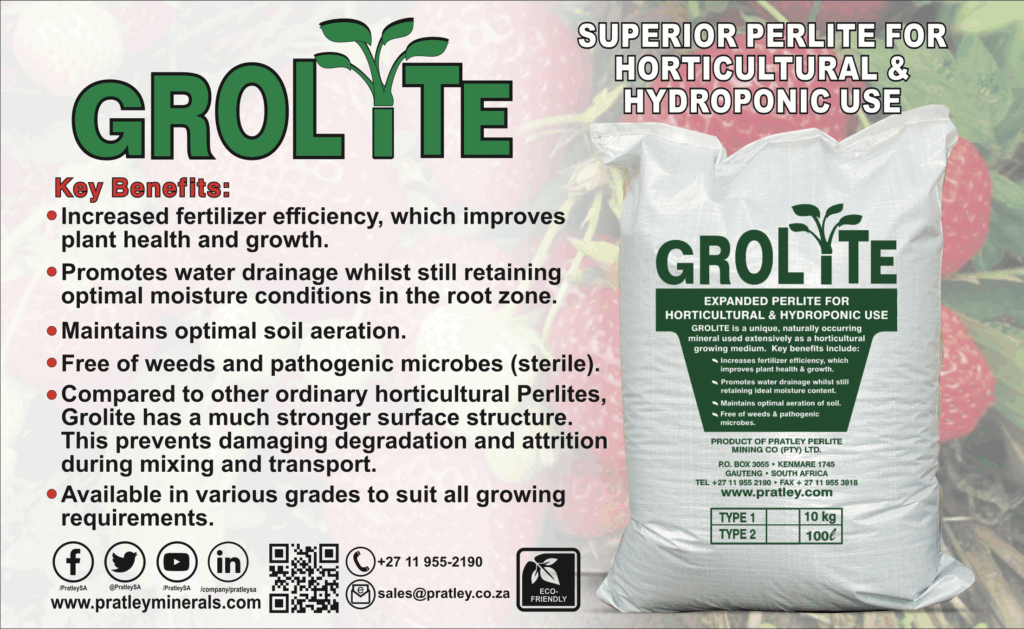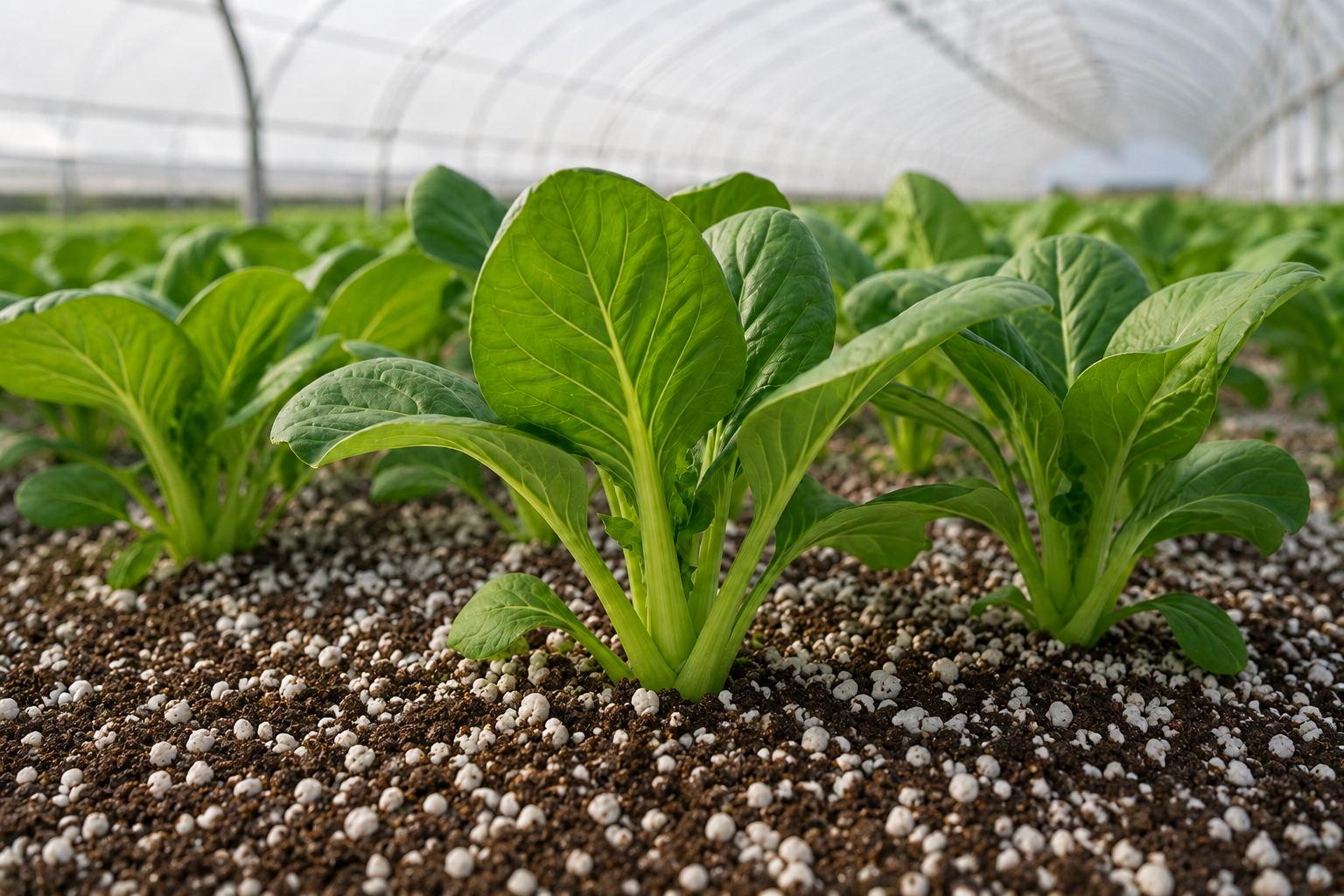
Choosing the right growing medium is one of the most decisive technical decisions in professional horticulture. In tunnel, greenhouse and shade-net production, growers are not simply filling bags, trays or beds. They are creating the physical environment in which roots must take up water, oxygen and nutrients every day of the production cycle.
For South African producers working under cover, this decision carries even more weight. Protected farming systems can deliver strong crop performance, but they also place pressure on irrigation accuracy, drainage, fertiliser use and root-zone hygiene. When the growing medium is poorly matched to the crop or irrigation programme, problems can appear quickly: waterlogging, uneven moisture distribution, restricted oxygen movement, poor root development and inefficient nutrient uptake.
This is where Grolite® Expanded Perlite from Pratley Minerals warrants decisive attention.
Grolite® is a naturally occurring volcanic mineral that is thermally expanded to create a lightweight, porous horticultural growing medium. It is not a synthetic growing medium. It is processed from perlite ore andexpanded into a structure that is highly relevant to modern root-zone management, especially where growers require drainage, aeration and moisture retention in the same medium.
For professional growers, Grolite® is not positioned as a miracle input. Rather, it should be understood as a practical substrate component with clear physical properties that support more balanced root-zone conditions when used correctly.
Why Growing Medium Choice Is a Decisive Production Factor
In protected horticulture, the root zone is the foundation of crop performance. Leaves, flowers and fruit may be the visible result, but root-zone conditions determine how efficiently the plant can access what it needs.
A growing medium must hold enough moisture for the plant, but not so much that the roots are deprived of oxygen. It must allow water to move through the profile, but still retain a usable amount of moisture around the root system. It must provide physical support while allowing air spaces to remain open. It must also fit into the irrigation and fertigation system used by the grower.
This balance is particularly important in intensive systems where crops are planted at high density and managed on tight irrigation cycles. Small mistakes in water movement can become large production problems. Too much retained water can lead to a saturated root zone. Too little retention can create rapid drying and inconsistent water availability. Poor aeration can slow root activity and reduce the plant’s ability to take up nutrients effectively.
The decisive point is simple: a growing medium is not passive. It actively influences how water, oxygen and nutrients behave around the roots.
What Is Grolite® Expanded Perlite?
Grolite® Expanded Perlite is a horticultural perlite product supplied by Pratley Minerals. Perlite is a naturally occurring volcanic mineral that expands when exposed to high temperatures. This thermal expansion creates a lightweight, porous material with a structure suited to horticultural use.
For growers, the value of this expanded structure lies in its ability to help manage the relationship between drainage and moisture retention. Grolite® promotes water drainage while retaining moisture conditions needed in the root zone. This is especially relevant in tunnel and shade-net systems where irrigation is often frequent and carefully managed.
Grolite® is also described as free of weeds and pathogenic microbes, giving it a clear role in systems where biosecurity and clean substrate handling matter. In intensive horticulture, reducing the risk of introducing weeds or soil-borne pathogens into the system is a decisive advantage, particularly where crops are grown in containers, bags or prepared beds.
The Decisive Root-Zone Balance: Drainage and Moisture Retention
Water management is one of the most important challenges in professional horticulture. A grower needs enough water in the medium to support plant growth, but excess water must be able to drain away.
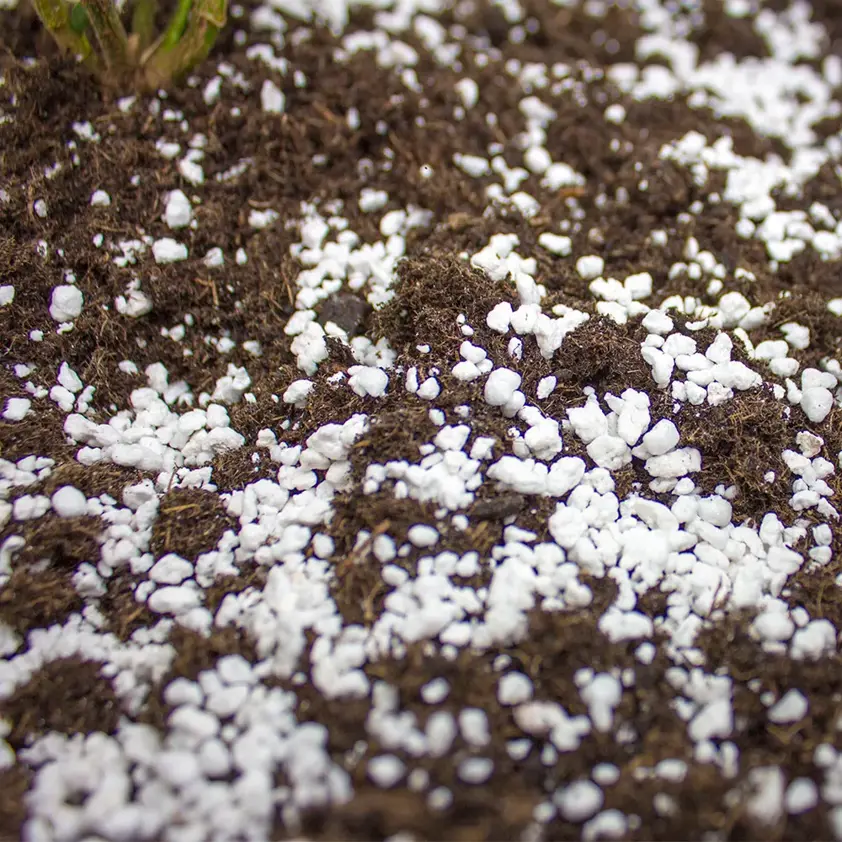
Grolite® addresses this balance through its expanded perlite structure. The material promotes drainage while still retaining moisture around the root zone. This makes it useful where growers want to avoid saturated conditions without creating a medium that dries too quickly.
In practice, this can help growers maintain a more consistent irrigation approach. Consistency is not the same as overwatering. It means that irrigation can be managed around the crop’s stage of growth, the weather conditions inside the tunnel or shade-net structure, and the characteristics of the growing medium.
The decisive issue is not only how much water is applied, but how that water behaves after application. A medium that drains poorly can create oxygen stress around the roots. A medium that holds too little water may require very frequent correction. Grolite® supports a more balanced approach by contributing both drainage and moisture-holding capacity.
Aeration: Why Oxygen in the Root Zone Matters
Roots need oxygen. In a protected horticultural system, root-zone oxygen movement is influenced by the physical structure of the growing medium. When air spaces are restricted, root function can be affected.
Grolite® maintains optimal aeration in the soil or growing medium. This is important because aeration supports oxygen exchange, healthy root development and nutrient uptake. For crops under cover, where production is often intensive and irrigation is frequent, this is a decisive part of substrate performance.
Poorly aerated media can limit root activity, particularly where water remains trapped in the profile. By improving air porosity, expanded perlite can help create a more suitable physical environment for roots. This does not remove the need for proper irrigation management, but it gives growers a more forgiving and functional root-zone structure to work with.
Fertiliser Efficiency and Nutrient Interaction
Fertigation is central to many professional tunnel and shade-net systems. Fertilisers are applied with irrigation water, and the growing medium influences how nutrients move and remain available near the roots.
Grolite® is positioned as improving fertiliser efficiency by enhancing nutrient interaction in the root zone. The surface structure of the expanded particles helps retain water and nutrient molecules, making them more readily available in the root environment.
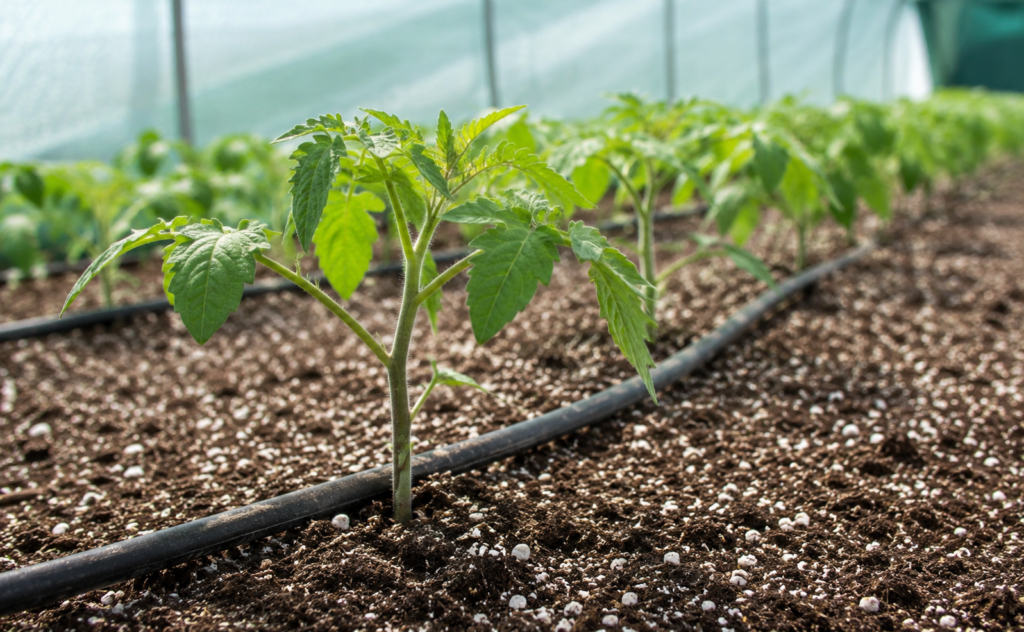
This should not be interpreted as a replacement for a fertiliser programme, crop monitoring or water analysis. It is better understood as a substrate-related support function. A medium with the right physical properties can help the fertiliser programme work more effectively because the root zone remains better balanced.
The decisive lesson for growers is that fertiliser efficiency depends on more than the fertiliser itself. It also depends on irrigation scheduling, drainage, oxygen availability, nutrient concentration, crop stage and the medium holding the root system.
Biosecurity Benefits in Intensive Systems
Biosecurity is a growing concern in professional horticulture. Disease pressure can move quickly through intensive production systems, especially where crops are grown in close proximity and managed under warm, humid conditions.
Grolite® is free of weeds and pathogenic microbes. This characteristic is important because it helps reduce the risk of introducing unwanted biological contaminants through the growing medium itself.
For growers producing seedlings, vegetables, herbs, ornamentals or hydroponic crops, starting with a clean medium can support better production discipline. It does not eliminate the need for hygiene protocols, clean water, sanitation, scouting or crop protection planning. However, it does remove one potential pathway for contamination.
In professional systems, this is a decisive operational benefit. Clean inputs help reduce avoidable risk.
Available Grolite® Grades and Their Practical Relevance
Grolite® is available in multiple grades to suit different horticultural requirements. The available grades include:
Fine Grade
Fine Grolite® is available in a 0–1mm grade. Finer particles may be more relevant where closer moisture contact and a finer-textured medium are required.
Medium Grade
The Medium grade is listed as 0–2mm. This grade can be considered where a grower needs a balance between fine particle behaviour and improved physical structure.
Coarse Grade
The Coarse Type 1 grade is listed as 1–3mm. Coarser particles generally contribute more air space and drainage behaviour, depending on the blend and application.
Unscreened Grade
The Unscreened grade is listed as 0–8mm. This provides a broader particle range and may suit applications where a less uniform particle size distribution is acceptable.
Type 2 Grades
Grolite® Type 2 variants include a Coarse grade of 1–8mm and a Fine grade of 0–1mm. These options allow growers to match the product to the intended application and growing system.
The decisive point is that grade selection matters. A grower should not only ask whether perlite is suitable, but which grade is suitable for the crop, container, irrigation method and production goal.
Where Grolite® Fits in Tunnel and Shade-Net Production
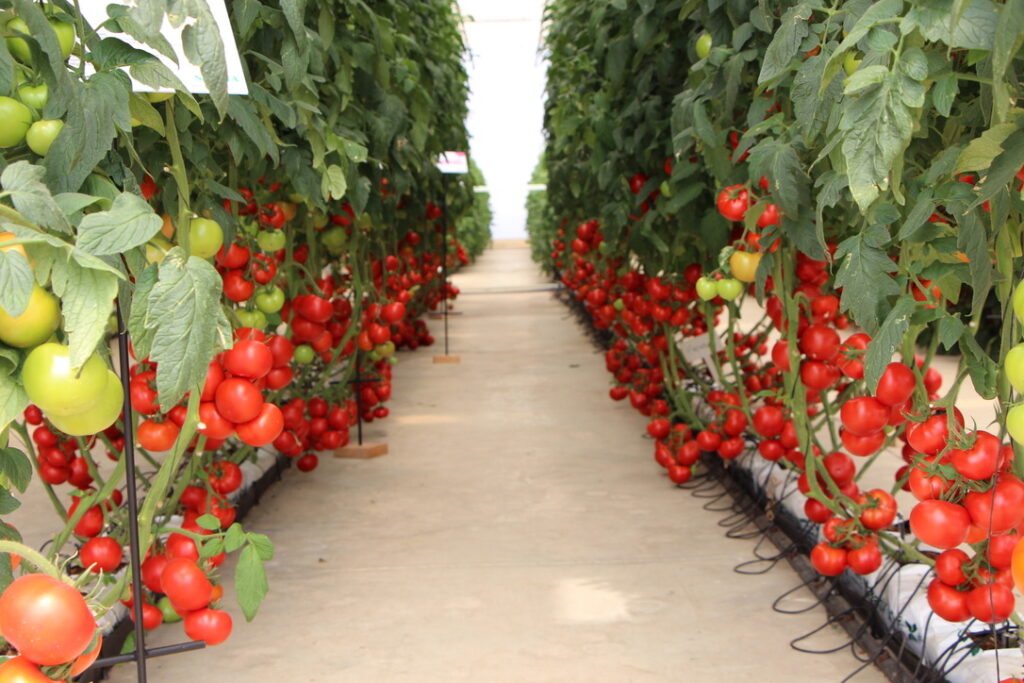
Grolite® is relevant to a range of professional horticultural applications, especially where growers need improved root-zone structure. Undercover systems often involve crops with high water and nutrient demand, frequent irrigation and a need for reliable drainage.
In tunnel systems, it may support root-zone aeration and moisture balance in containers, bags and substrate mixes. In shade-net production, it can help where growers require better drainage and reduced risk of saturated conditions after irrigation or rainfall exposure.
Grolite® may also have relevance in hydroponic systems where perlite is used as a growing medium or substrate component. As always, the irrigation and nutrient programme must be matched to the crop and system.
This is not a one-size-fits-all input. The decisive value lies in choosing the correct grade, applying it in the correct production context, and managing irrigation accordingly.
Why Local Supply and Technical Consistency Matter
Professional growers do not only evaluate a product by its physical properties. They also need reliability of supply, consistent quality and supplier credibility.
Pratley Minerals operates from Krugersdorp, Gauteng, and supplies local and international markets. The company is ISO certified and is a member of the International Perlite Institute. For South African growers, local availability and established minerals-processing experience are important considerations when planning substrate procurement.
Perlite is sourced from South Africa and processed using proprietary technology developed by the Pratley group. The company’s minerals-processing history includes the establishment of its first perlite processing factory in 1974.
For growers managing commercial crop cycles, these supply-chain factors can be decisive. A growing medium must be available when needed, consistent enough for repeated use, and supported by a supplier that understands the material.
A Natural Growing Medium for Sustainability-Conscious Producers
Sustainability is increasingly important in horticulture, particularly where producers supply formal markets or export channels. Buyers and consumers are paying closer attention to production practices, input choices and environmental positioning.
Grolite® is classified as eco-friendly by Pratley Minerals. It is a naturally occurring mineral and not a synthetic manufactured product. This gives it relevance for producers seeking a substrate option with a natural mineral origin.
It is still important for growers to evaluate sustainability in a full production context. Transport, irrigation efficiency, fertiliser use, crop performance and waste management all contribute to the broader environmental footprint of a production system.
However, the use of a natural, mineral-based growing medium that supports drainage, aeration and root-zone balance can form part of a more deliberate and decisive approach to input selection.
Practical Questions Growers Should Ask Before Using Grolite®
Before adopting any substrate or substrate component, growers should ask a few technical questions.
What crop will be grown?
Different crops have different root systems, water requirements and sensitivity to waterlogging. Crop type should guide medium choice.
What irrigation system is being used?
Drip irrigation, hand watering, fertigation and hydroponic systems all interact differently with the growing medium.
What container or bed system is being used?
Bags, trays, pots and soil beds each influence drainage, evaporation and root-zone volume.
Which grade is most suitable?
Fine, medium, coarse and unscreened grades behave differently. Grade selection should match the crop and production system.
How will fertiliser be managed?
Because Grolite® supports nutrient interaction at the root zone, fertiliser planning should still be based on crop needs, water quality and monitoring.
Is hygiene a priority?
In intensive systems, the weed-free and pathogen-free nature of Grolite® is a valuable consideration.
These questions help turn product selection into a decisive management decision rather than a simple purchase.
Grolite® Is Not a Substitute for Good Management
No growing medium can replace good production management. Grolite® can support drainage, aeration, moisture retention and cleaner root-zone conditions, but results will still depend on irrigation timing, crop nutrition, water quality, climate control and disease management.
Growers should monitor crop response, inspect root health, adjust irrigation according to crop stage and keep records. Where possible, substrate choice should be supported by practical trials on the farm before large-scale adoption.
The decisive approach is to treat Grolite® as part of a professional production system. It is a root-zone tool, not a standalone solution.
The Bottom Line
Professional horticulture depends on precision. Undercover growers must manage water, air, nutrients and hygiene in a confined root-zone environment where small imbalances can affect the whole crop.
Grolite® Expanded Perlite offers a natural, mineral-based growing medium with properties that align with these requirements. It promotes drainage while retaining useful moisture, supports root-zone aeration, improves fertiliser efficiency and is free of weeds and pathogenic microbes. It is available in several grades, giving growers flexibility across different crops and production systems.
For South African tunnel, greenhouse and shade-net producers, the growing medium is a decisive part of production planning. Where root-zone balance, clean inputs and reliable physical performance are priorities, Grolite® Expanded Perlite deserves serious consideration.
For more information, visit www.pratleyminerals.com.
Frequently Asked Questions About Grolite® Expanded Perlite
What is Grolite® Expanded Perlite?
Grolite® Expanded Perlite is a naturally occurring volcanic mineral that is thermally expanded for horticultural and hydroponic use.
Is Grolite® synthetic?
No. Grolite® is not a synthetic product. It is a processed natural mineral.
What does Grolite® do in the root zone?
It supports drainage, moisture retention and aeration, helping create a more balanced physical environment for roots.
Is Grolite® suitable for tunnel farming?
Yes, it is relevant to tunnel and protected horticultural systems where drainage, aeration and root-zone balance are important.
Can Grolite® be used in shade-net production?
Yes. It may be useful in shade-net systems where growers need improved drainage and better moisture management.
Is Grolite® free of weeds and pathogenic microbes?
Grolite® is described as free of weeds and pathogenic microbes, supporting cleaner substrate handling in intensive systems.
What grades are available?
Available grades include Fine, Medium, Coarse, Unscreened and Type 2 variants.
Does Grolite® replace fertiliser?
No. It does not replace a fertiliser programme. It supports fertiliser efficiency by improving nutrient interaction in the root zone.
Is Grolite® eco-friendly?
Pratley Minerals classifies Grolite® as eco-friendly, and it is based on a naturally occurring mineral.
Why is Grolite® a decisive option for growers?
Because it supports several core root-zone requirements at once: drainage, moisture retention, aeration, cleanliness and consistent substrate structure.
(M.O)