
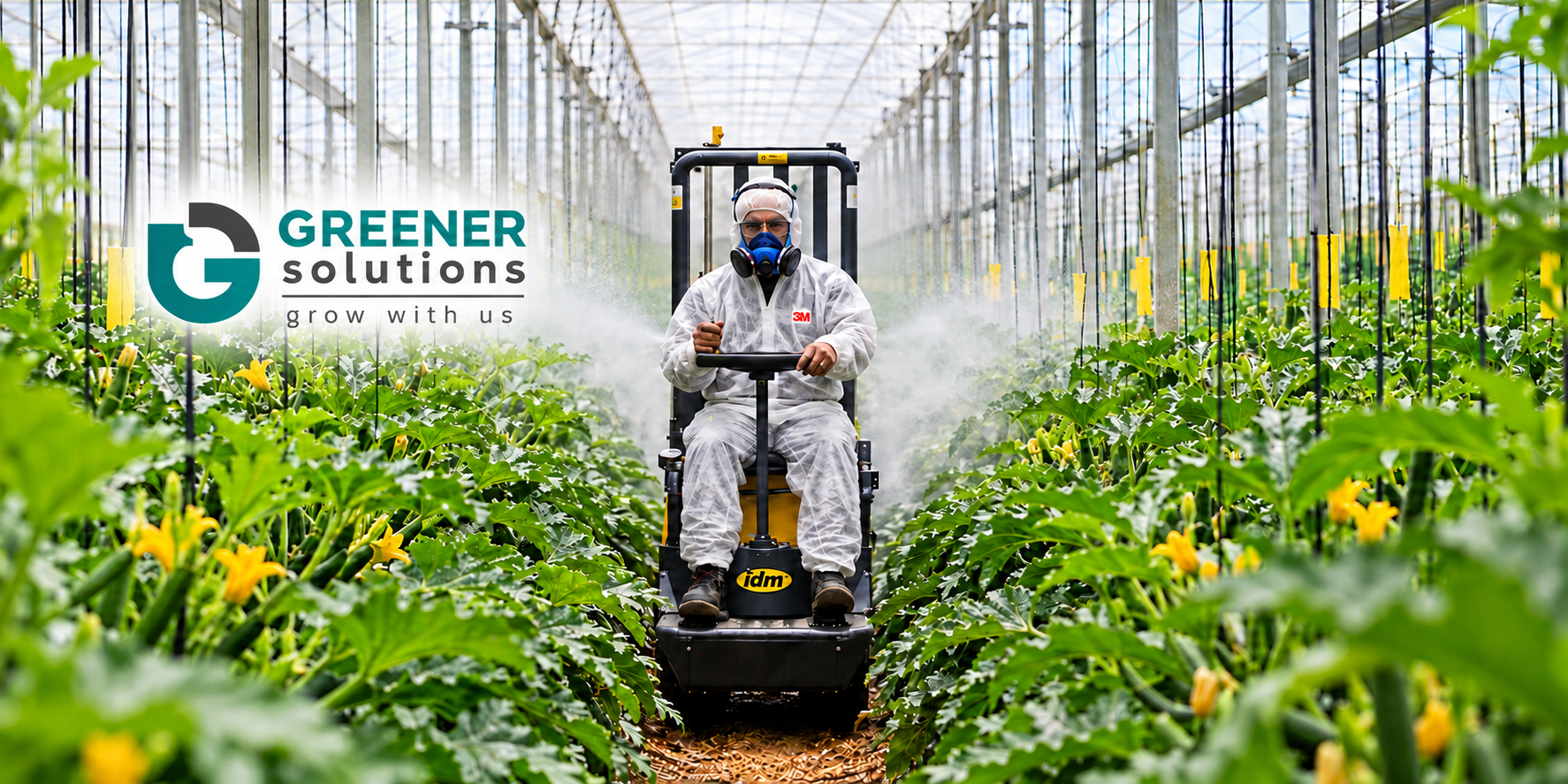
Transformative IDM greenhouse machinery is helping commercial growers improve efficiency, worker safety and profitability in modern greenhouse production. Supplied by Greener Solutions across South Africa and the SADC region, the IDM range is designed to tackle some of the biggest daily challenges in protected cropping, from elevated crop work and internal transport to precise crop protection.
Modern greenhouse and open-field horticulture is a game of margins. Every hour of labour, every litre of agrochemical and every metre of aisle space either contributes to the crop or eats into return on investment. That is why smarter thinking around equipment selection matters more than ever in commercial horticulture.
For growers across South Africa and the SADC region, Greener Solutions brings more than 25 years of hydroponic and greenhouse experience to the table, pairing proven technology with local knowledge. A key part of that offering is the IDM range of intelligent agricultural machinery, developed to make greenhouse work safer, more efficient and more profitable. The value of the range lies not in automation for its own sake, but in how each machine targets a real operational constraint.
Three categories consistently stand out: A4R trolleys for greenhouse cultivation, harvesting carts and sprayers. Together they address elevated crop work, internal transport and crop protection — three areas where small inefficiencies can compound across an entire production cycle. In practical terms, effective greenhouse technology should give workers more time on the crop and less time fighting the environment around it.
A4R Trolleys: Better Access for High-Wire Crops
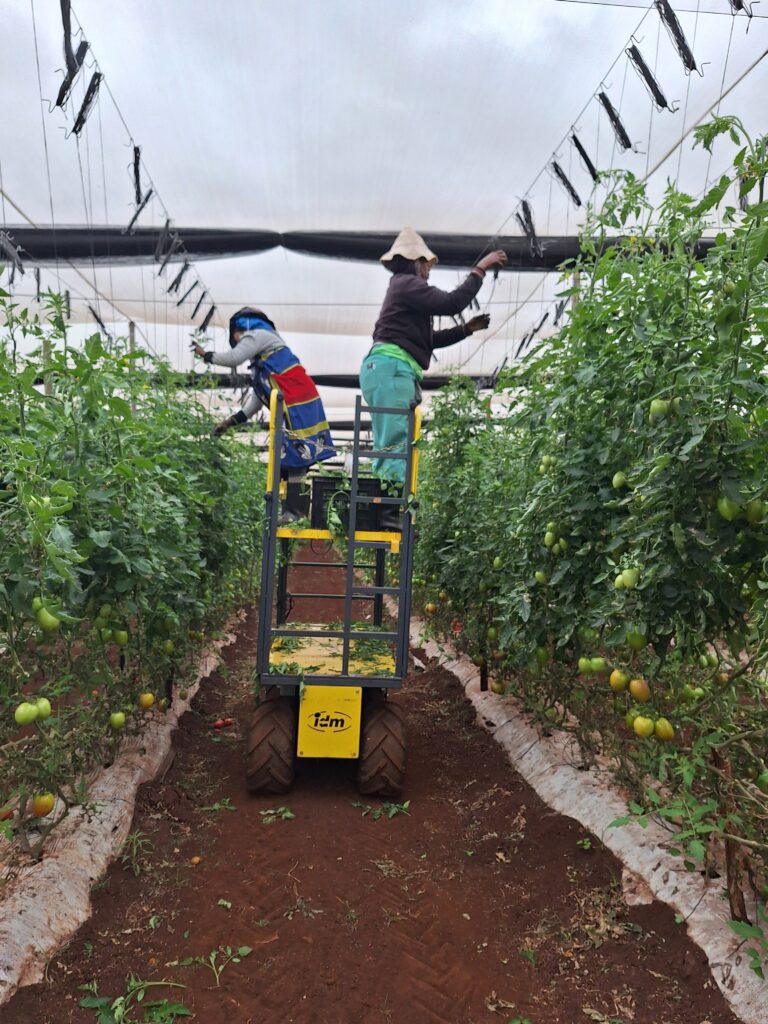
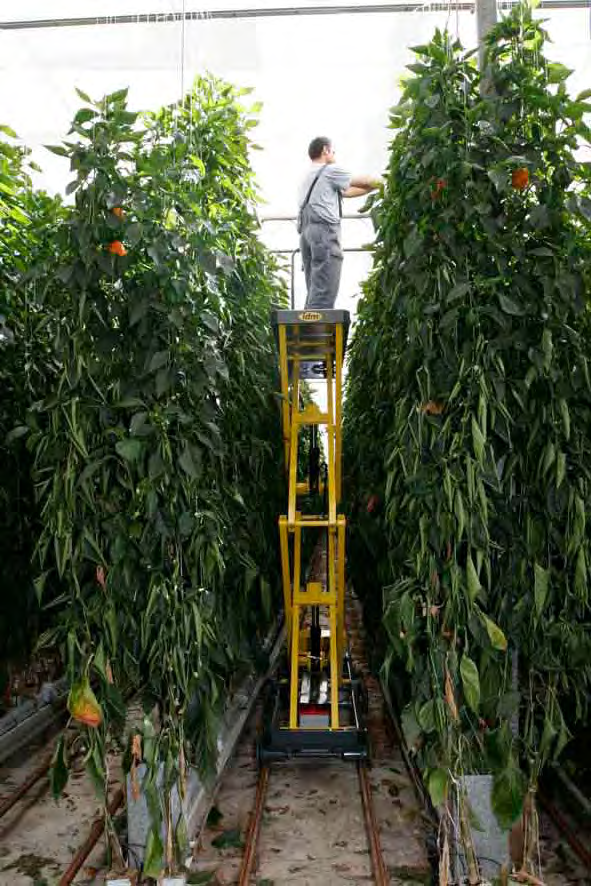
High-wire production creates a simple challenge: crops keep growing upward, while workers remain on the ground. Ladders, improvised platforms and repeated climbing all cost time and introduce unnecessary strain.
The A4R trolley is IDM’s most requested access solution for growers operating on rubber wheels rather than pipe-rail infrastructure. It uses a rechargeable electric and reversible drive system on a narrow wheel track suited to greenhouse row spacings. The working platform lifts to a maximum height of 3,500 mm and includes an aluminium grid skid floor, with floating control knobs allowing smooth control of speed and direction.
Power is supplied by a 0.5 hp motor-reducer with two 12V lead-acid batteries in series. Electronic variable speed, ramp acceleration and smooth braking help operators move safely through tight greenhouse rows, while steering can be manual or electrically controlled.
What makes the A4R especially transformative in South African facilities is its suitability for ground sheeting, the most common floor type in many greenhouse operations. It provides a cost-effective alternative to hydraulically lifted platforms and uses foot-pedal stop-start control, keeping workers’ hands free for crop work.
Greener Solutions notes that workers can spend around 90% of their time with their hands on the crop rather than climbing ladders, climbing trolleys or holding onto the trolley for much of the day. That is a transformative shift because labour is redirected from access to actual plant work.
For pruning, clipping, training and harvesting, that small operational change can have a measurable effect across thousands of repeated movements during a season.
Harvesting Carts: Smarter Internal Logistics
Harvesting does not end when produce leaves the plant. Crates still need to move through narrow rows to a collection point, packing area or internal transport route, and that movement can consume almost as much labour as the harvest itself.
IDM’s harvesting carts are designed around this hidden cost. Their four-wheel steering system allows them to turn in tight spaces, while the lightweight design makes them practical to manoeuvre along greenhouse aisles. They can be used from either side and include a push-pull bar positioned at hip height.
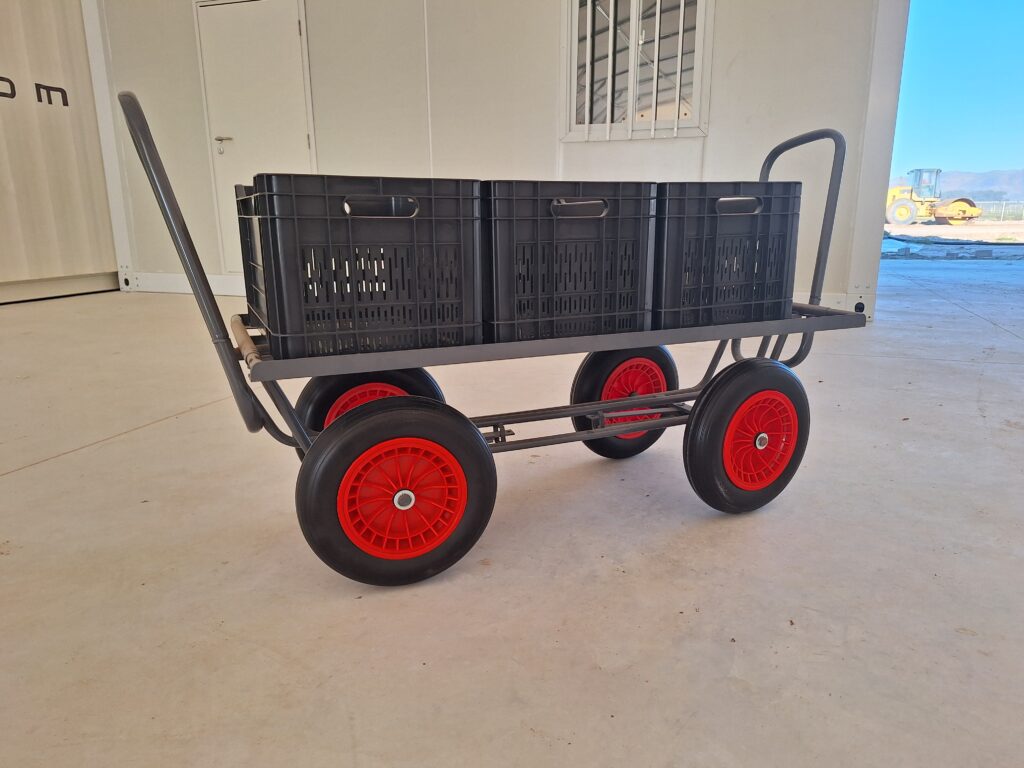
The adjustable platform carries between three and six crates and can accommodate most common crate sizes. Large rubber wheels reduce rolling resistance and make movement easier during harvesting and other routine tasks.
The transformative benefit is straightforward: workers spend less energy carrying, dragging and repositioning loads, and more time keeping the harvest moving. In high-output operations, better logistics do not need to look dramatic. They simply need to remove friction from a task repeated hundreds of times a day.
That is why a seemingly simple harvesting cart can become an important piece of equipment when labour efficiency is under pressure.
Sprayers: Transformative Crop Protection with Greater Precision
Crop protection is one of the highest-risk and highest-cost activities in a greenhouse. Poor application can waste expensive product, leave parts of the crop inadequately treated and increase operator exposure.
IDM’s flagship Fumimatic is a ride-on sprayer designed specifically for protected crops. It is powered by either a 26HP Lombardini-Kohler engine or a 35HP Kubota engine and uses a hydrostatic transmission with independent 6×6 skid-steer drive for full six-wheel traction across soft or uneven greenhouse floors.
Its 400-litre tank feeds a piston pump delivering 50 litres per minute at up to 40 bar. Tri-directional treatment bars use ceramic-plate, 80-degree hollow-cone nozzles, while the spray system can be adjusted in width and height according to the crop being treated.
The transformative advantage lies in consistency. A more homogeneous spray pattern, better penetration and adjustable delivery can help growers apply treatments more precisely across varying crop heights.
For operations seeking similar reliability at a more accessible price point, IDM’s Model 300 offers a 4×4 hydraulic-drive alternative. It uses a 26HP Lombardini-Kohler engine, hydraulic motors on each wheel, a small turning radius and an adjustable spray boom for crop height and width.
Across the range, triple-flow nozzles allow different spray rates at different heights. The machines are designed for easy driving, high manoeuvrability, good canopy penetration and safe application.
The client document states that the machines are recommended by the European Crop Protection Association, ECPA, and that ECPA tests recorded a 75% reduction in worker exposure together with a 30% saving in phytosanitary products.
Those figures illustrate why transformative crop protection is not only about machinery performance; it is also about reducing waste and improving safety.
When a grower can use less product while achieving a more even treatment and reducing worker exposure, that is a transformative operational result.
One Partner, One Range, One Transformative Objective: Profitability
What ties the IDM range together is a single design principle: machines should reduce labour, protect crop quality and improve the safety of work performed inside the greenhouse.
That principle is transformative because it connects equipment investment directly to daily production economics. An access platform should not merely lift a worker. A harvesting cart should not merely carry crates. A sprayer should not merely apply chemical. Each machine should solve a measurable operational problem.
The broader IDM range also includes specialised equipment such as the Fumirail, a self-propelled fumigation system for pipe-rail greenhouses, and the ACH-2800, a double scissor-lift platform designed for high-density pipe-rail cultivation frameworks.
Greener Solutions can advise growers on where these machines fit alongside the core range, depending on the structure of the greenhouse and the production system in use.
This ability to match technology to the operation is one of the most transformative parts of the process. Investment should fit the greenhouse rather than forcing the greenhouse to fit the machine.
IDM describes its products as machines for intelligent agriculture. The phrase becomes meaningful when a machine removes wasted movement, improves treatment quality or frees workers to spend more time on productive crop tasks.
That is where transformative equipment earns its place: not as a gadget, but as part of a more disciplined production system.
Why Greener Solutions Matters
Greener Solutions applies the same standard to machinery that it applies to its greenhouse and hydroponic technology. From the first discussion about an operation, through system design and equipment selection to delivery and operation, the company aims to provide growers with practical advice and service.
For growers, that local support can be transformative because the right machine is only valuable if it suits the crop, the greenhouse floor, the row spacing, the labour structure and the production goals.
If elevated crop work is consuming too much time, if internal logistics are slowing harvest, or if spraying is using more product and exposing workers more than it should, the IDM range gives growers a practical route to more transformative efficiency.
Ultimately, the most transformative greenhouse machinery is the machinery that solves a real problem and pays its way through better labour use, safer operation and more consistent production.
Q&A: IDM Greenhouse Machinery and Greener Solutions
1. What makes the IDM range transformative for greenhouse growers?
The range is transformative because it focuses on three recurring operational pressures: access, transport and crop protection. The A4R trolley, harvesting carts and sprayers are designed to reduce wasted movement, improve safety and support more consistent production.
2. Is the A4R trolley a transformative option for greenhouses without pipe rails?
Yes. The A4R is particularly relevant to greenhouses using conventional floors and groundsheeting. Its electric drive, 3,500 mm maximum platform height and foot-pedal control make it a transformative alternative to repeated ladder use or more expensive hydraulic platforms.
3. How can harvesting carts create transformative labour savings?
Their four-wheel steering, large rubber wheels and adjustable crate platform reduce the effort required to move harvested product through narrow rows. The transformative gain comes from making a repetitive task faster and easier throughout the working day.
4. What makes IDM sprayers a transformative crop-protection option?
The Fumimatic and Model 300 are designed around manoeuvrability, adjustable application and more uniform spray coverage. Their transformative value lies in helping growers improve treatment quality while reducing unnecessary product use and worker exposure.
5. Are the ECPA results relevant to transformative greenhouse management?
Yes. The client document states that ECPA testing recorded a 75% reduction in worker exposure and a 30% saving in phytosanitary products. If those efficiencies are achieved in practice, they represent a transformative improvement in both safety and input management.
6. How should a grower decide which transformative IDM machine is right for the operation?
The decision should begin with the production bottleneck. A grower struggling with high-wire crop work may need an A4R trolley, while another operation may benefit more from transformative harvesting logistics or a more precise sprayer.
Greener Solutions can advise according to greenhouse structure, crop system and operational needs, helping growers identify where transformative changes can produce the greatest practical return.
For growers considering IDM greenhouse machinery in South Africa or the wider SADC region, Greener Solutions can assist with equipment selection, system design, delivery and operational support.
Visit greenersolutions.co.za to discuss which transformative IDM solution best suits your greenhouse and where the greatest operational gains can be achieved.
Written by (M.O)